> For the complete documentation index, see [llms.txt](https://docs.seda.xyz/home/llms.txt). Markdown versions of documentation pages are available by appending `.md` to page URLs; this page is available as [Markdown](https://docs.seda.xyz/home/technology/seda-network-architecture/the-overlay-network.md).
# The Overlay Network
Powering permissionless and decentralized access to any API.
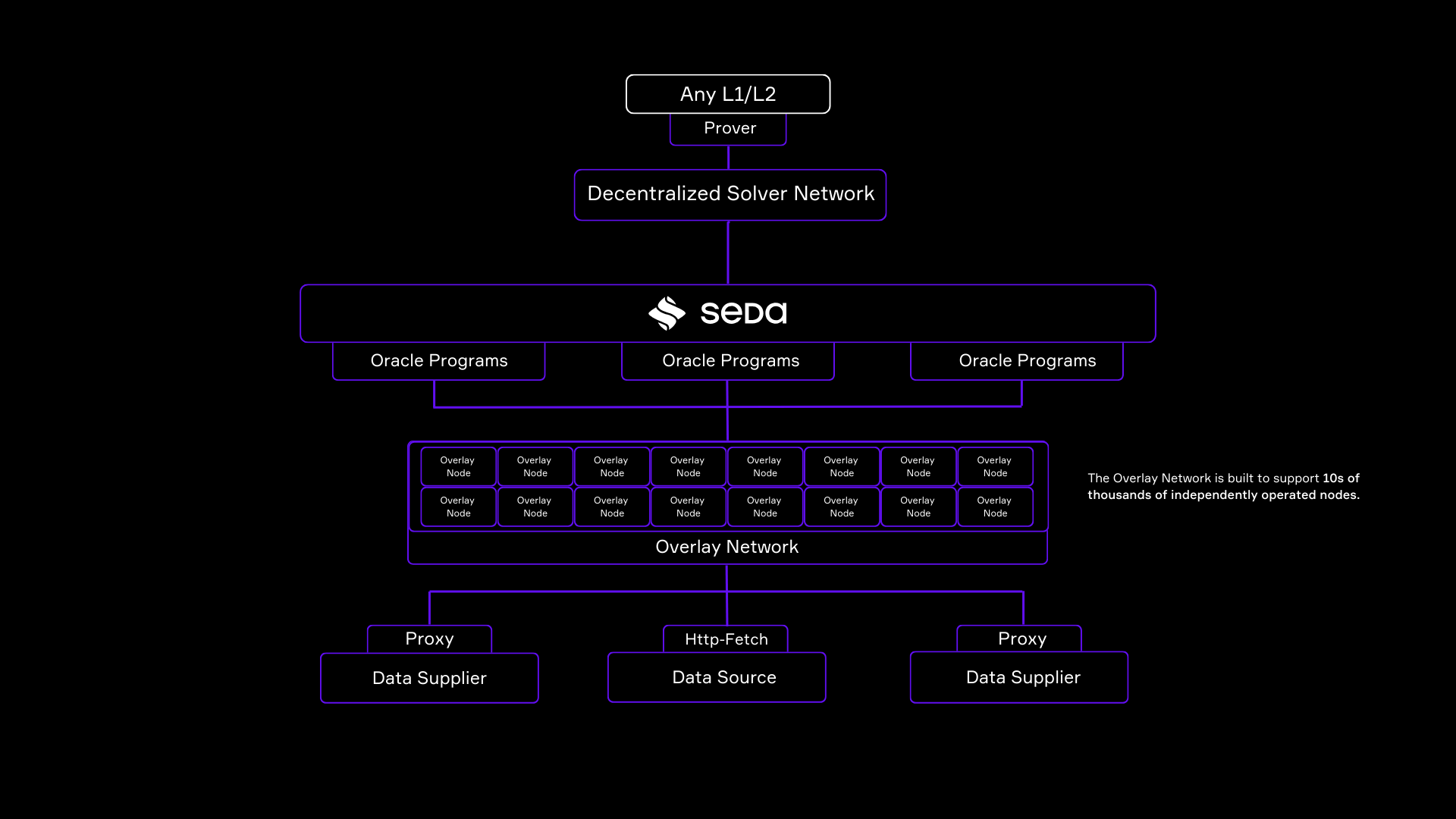
The Overlay Network is a multi-party computational network built to host tens of thousands of independently operated nodes. The primary responsibility of The Overlay Network is to query data sources as defined by a protocol Oracle Program. By leveraging an Overlay Network SEDA operates a highly decentralized data retrieval system while facilitating increased community participation.
When a data request is issued to the SEDA Network, Overlay Nodes form secret committees. The amount of nodes in a secret committee is determined by the protocol's customized replication factor, configured in their Oracle Program. This secret committee then queries the data sources also specified in an Oracle Program and individually returns data results via a commit reveal scheme. This process maintains data integrity and decentralized data querying, reducing trust of a single source of truth.
Participating in The Overlay Network is designed to be permissionless. Similarly to the operation parameters of main chain nodes, participants may stake SEDA Tokens to Overlay Nodes to perform the operation.
{% hint style="info" %}
The Overlay Network will launch in phases, with phase one consisting of a whitelisted selection of professional validator companies.
{% endhint %}
---
# Agent Instructions
This documentation is published with GitBook. GitBook is the documentation platform designed so that both humans and AI agents can read, navigate, and reason over technical content effectively. Learn more at gitbook.com.
## Querying This Documentation
If you need additional information that is not directly available in this page, you can query the documentation by asking a question.
Perform an HTTP GET request on the following URL with the `ask` and `goal` query parameters:
```
GET https://docs.seda.xyz/home/technology/seda-network-architecture/the-overlay-network.md?ask=&goal=
```
`ask` is the immediate question: it should be specific, self-contained, and written in natural language.
`goal` is what the user is ultimately trying to achieve, the reason they need the answer. Sharing it helps GitBook give you a better, more relevant answer. A goal is most helpful when it describes the outcome the user wants rather than restating the question. For example, with `ask=how do I create an API token`, a goal like `automate deployments from our CI pipeline` lets GitBook tailor the answer to that use case.
The response will contain a direct answer to the question and relevant excerpts and sources from the documentation.
Use this mechanism when the answer is not explicitly present in the current page, you need clarification or additional context, or you want to retrieve related documentation sections.